Your buyer's lender is fine. Their down payment is wired. Then, ten days before closing, their insurance quote lands three thousand dollars higher than the estimate they used to write the offer, and the request for a price concession follows the same afternoon. In a Boca Raton market where the sale-to-list ratio sat at 92.65% in Q1 2026 and 83% of active listings had already taken a price reduction, that concession is where the deal is now won or lost.
The mechanism behind it changed on June 1, 2026, and most sellers of older Boca homes have not caught up to what that means for their listing.
What the June 1 reset actually did
Two things happened at once. First, Citizens Property Insurance began applying premium reductions at Spring 2026 renewals, with a statewide average of 8.7%, and Palm Beach County's roughly 26,000 Citizens-insured homes received an average reduction of 11.9%. Second, and more consequential for a Boca seller, Citizens itself is no longer a realistic fallback for a buyer who cannot place coverage in the private market.
Palm Beach County led Southeast Florida with a 65% year-over-year decline in Citizens policies, and Citizens lowered average personal-lines rates for the first time since 2015. As Mark Friedlander of the Insurance Information Institute put it in early March, "Citizens is back in a position where it is truly a last resort insurer," and "Private insurers are now taking on most of the risk in Florida." That is not a talking point. It is a change to the closing table. Under state law, homeowners cannot renew with Citizens if a private carrier offers a policy priced within 20% of Citizens' rate, which means your buyer will almost certainly be underwritten by a private company you have never heard of, using two documents most sellers have never commissioned.
Those two documents are the 4-point inspection and the wind mitigation report. In 2026, they price the deal.
Why two inspections now sit between you and the closing table
A 4-point inspection is a focused review of the four systems that private carriers use to decide whether they will write the policy at all. It covers roof, electrical, plumbing, and HVAC, and Florida insurance companies require it before they will write a new homeowners policy on most older homes. It is the insurer's way of deciding whether your home is a risk they are willing to take.
The wind mitigation report is different. It does not decide whether the buyer can get a policy. It decides what that policy costs. Florida law requires insurers to offer premium credits based on specific construction features that reduce wind damage risk, and those credits are attached to the property, not the owner. If your buyer's premium comes in high because your home has no documented credits, that number goes straight into their offer-revision math.
The distinction matters because Boca's housing stock lines up almost exactly with the age brackets these reports were designed to catch.
The 4-point, decoded by carrier age threshold
Carrier thresholds have loosened for 2026, but the sequence still applies to most of Boca east of I-95. Heading into this year:
| Home age | What most carriers require |
|---|---|
| Under 20 years | Usually no 4-point requested |
| 20 to 25 years | Some carriers, including Citizens, still require one |
| 25 to 30 years | Most private carriers require one |
| 30 to 40 years | Almost universal requirement |
| 40+ years | Universal, with tighter scrutiny of each system |
That framework comes from carrier underwriting guidelines heading into 2026, where 40 years is almost universal, 30 is common, and some still start at 20, though the hard 20-year cutoff that used to be universal has loosened. A typical 1985 ranch in Boca Square or a 1978 townhome in Boca West sits squarely inside the strictest bracket.
What actually causes declinations, rather than repricing, is narrower than most sellers assume. The two failure points that end deals: HVAC older than 13 years, roof older than 20 years, electrical not updated to circuit breakers and copper wiring, and water heater older than 15 years. Federal Pacific, Zinsco, Challenger, and Sylvania panels are effectively uninsurable with most carriers, and aluminum branch wiring is accepted by only a small subset of the Florida market even after remediation. If any of those items exist in your home and you learn about them from your buyer's inspector rather than your own, you have already lost leverage.
The wind mitigation report is a pricing sheet, not a formality
Here is where sellers most often leave money on the table. A wind mitigation inspection typically costs $75 to $150, and the report is valid for five years. An inspector grades the features that drive the buyer's premium:
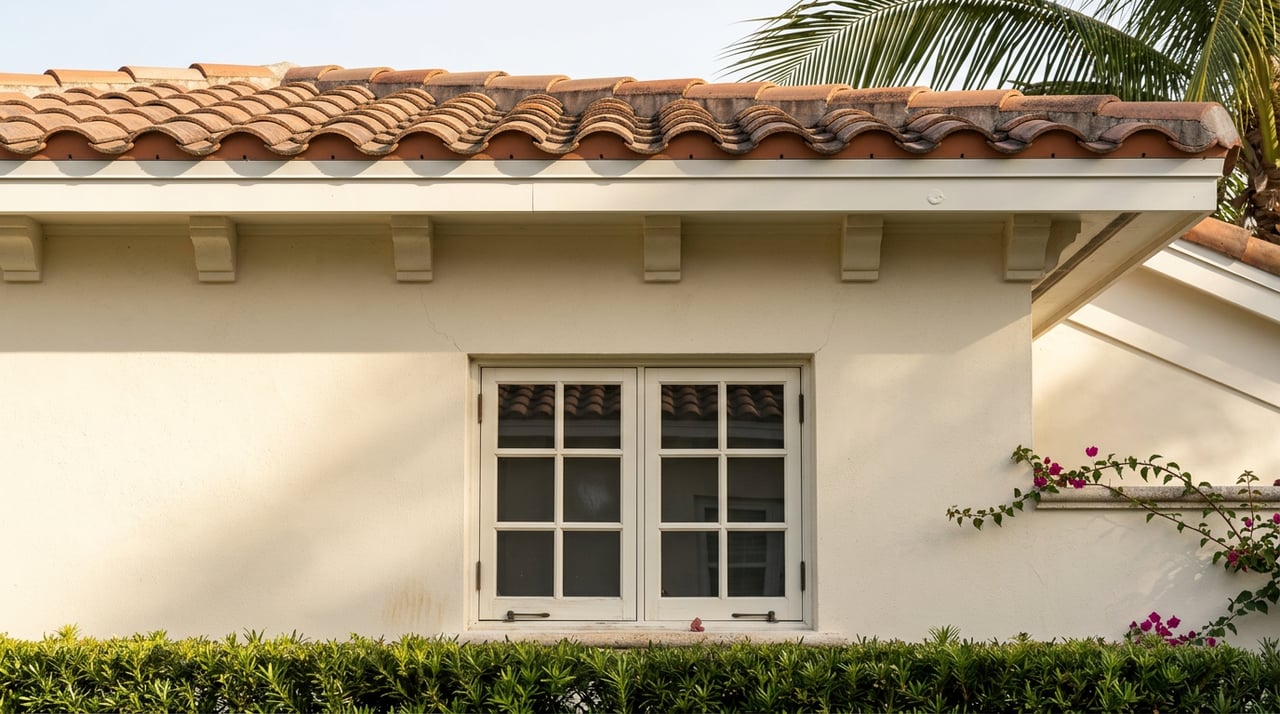
- Roof shape. Hip roofs, sloped on all four sides, perform significantly better in high winds than gable roofs and earn the largest credits.
- Roof-to-wall attachment. Clips, single wraps, and double wraps each earn different credit levels.
- Roof deck attachment. The fastener type and spacing between the deck and the trusses.
- Roof covering. Whether the roof meets current Florida Building Code.
- Secondary water resistance. A membrane layer applied under the roof covering.
- Opening protection. Impact glass or Florida-approved shutters on every opening, including skylights and garage doors.
The report matters most for homes built before the post-Andrew code. If your home was built after 2002, when Florida adopted its post-Andrew building code, you likely qualify for some credits even without any upgrades. Everything east of Federal Highway that predates that code is a candidate for either a large credit, if the features are documented, or a large premium hit, if they are not.
A Boca seller who hands the buyer a completed wind mitigation report with strong marks converts an unknown quote into a fixed one. That is the difference between an offer written on a worst-case premium estimate and an offer written on the actual number.
What to do before the sign goes up
The listing prep sequence that fits the 2026 reset:
- Order both inspections together. Boca-area inspectors, including firms like Kore Home Inspections, RCI Home and Mold Inspections, and Florida State Home Inspectors, will bundle a 4-point and a wind mitigation visit. Ask the inspector to do both at the same visit; it is cheaper to bundle them, and the reports are ready when you need them.
- Read the 4-point before the buyer does. If it flags a panel, a fifteen-year water heater, or an aged HVAC, you have three weeks to remediate on your terms. Discovered mid-contract, the same items become concessions.
- Chase every wind mitigation credit you already own. Impact glass installed in 2010 is worth nothing to the buyer's carrier without the product-approval paperwork. If you plan upgrades, pull permits first; for work in the City of Boca Raton or unincorporated Palm Beach County, permits create a clear paper trail that eases insurer acceptance.
- Assemble a permit and product-approval folder. Roof permit, opening-protection Florida product approvals, and any post-2002 code compliance letters live here. Hand it to your agent, not the buyer's inspector.
- Include both reports in the listing package. In a buyer-leverage market where the June 2026 median sale price was $669,900 and homes sold in an average of 75 days, a listing that pre-answers the insurance question moves faster than one that does not.
The reason all of this matters is not that inspections are new. It is that the buyer's backstop is gone. When Citizens was writing hundreds of thousands of Palm Beach County policies, a buyer whose private quote came in high could shrug and take Citizens. In 2026 they cannot, and the negotiating pressure that used to be absorbed by the state carrier now lands directly on the seller's price.
FAQ
How old does my Boca home have to be before a buyer's carrier will ask for a 4-point? It depends on the carrier. The strictest still start at 20 years. Most private carriers request one at 30. By 40, it is essentially universal. Assume your buyer's carrier will ask if the home was built before 2000.
If I already have a wind mitigation report from three years ago, is it still valid? Usually yes. The report is valid for five years, provided none of the graded features have changed. A new roof or new impact windows since the report was issued means it is worth updating.
Do the credits go to the seller or the buyer? Neither, technically. Wind mitigation credits attach to the property. Your buyer inherits whatever the home qualifies for, which is why a documented report is more valuable than an undocumented one.
Is a general home inspection enough? No. Assuming a general home inspection is enough is a common mistake; insurers typically require a wind mitigation report with specific verifications. The two are separate reports with separate purposes.
If you are preparing to sell a home in Boca Raton and want the two reports handled correctly before the listing goes live, Debbie Gross can coordinate the inspectors, permit review, and pricing strategy so the buyer's insurance quote works for you instead of against you. Schedule a Free Consultation.