Two waterfront listings can carry the exact same number on the flyer, both claiming roughly 100 feet of frontage on the Intracoastal, and still be worth millions apart. The difference rarely shows up in the listing photos. It shows up at the first low bascule bridge between the dock and the inlet, in the water depth the survey never mentions, and in whether the marina down the block has an open slip or a waitlist longer than the mortgage term.
Buyers comparing Palm Beach corridor waterfront, from Jupiter down through Manalapan, tend to shop on frontage because it is the easiest number to filter by. It is also the least useful one for predicting what a house is actually worth to a boat owner. Frontage tells you how much dock you could theoretically build. It says nothing about whether a vessel can get from that dock to open water without stopping at a bridge that will not open for it, or without running aground in a channel that silted in since the last survey.
The Frontage Number Only Measures One Thing
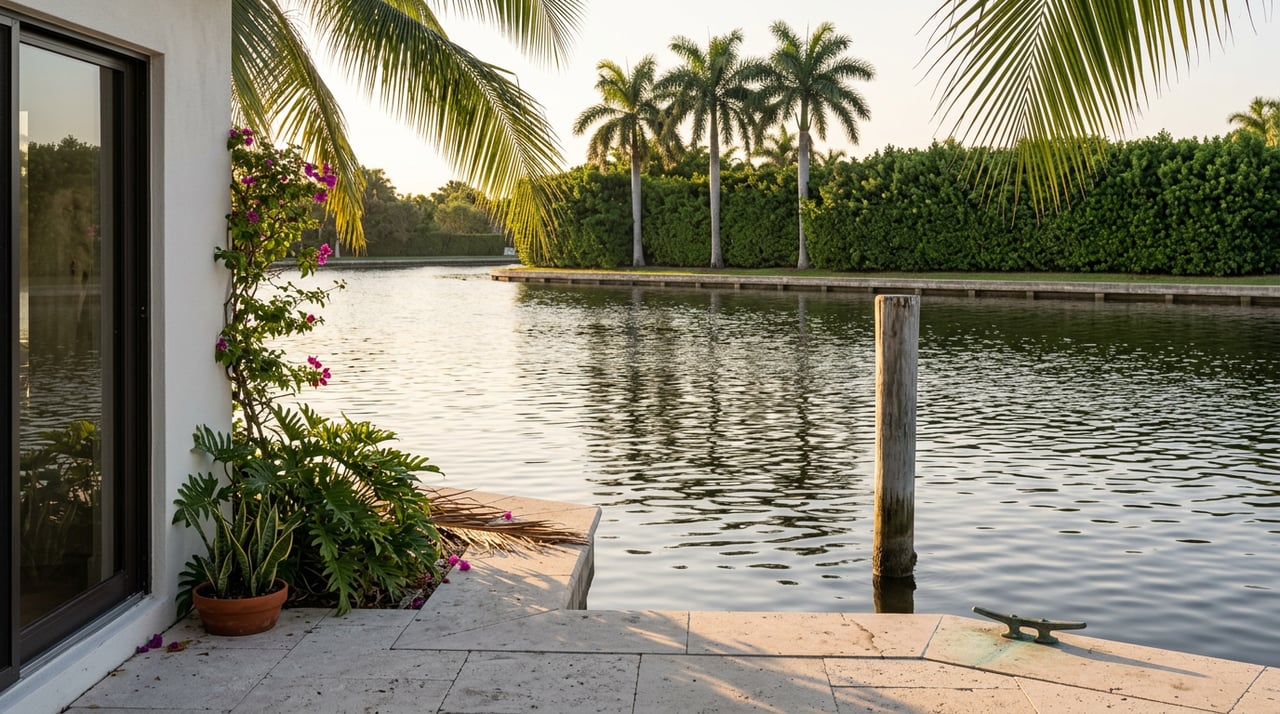
A listing that reads "150 feet of waterfront" is describing a property line, not a route. On a barrier island where the Intracoastal Waterway threads through nearly every luxury enclave between West Palm Beach and Jupiter, protected dockage on the inside of the island is common. A clear, unobstructed run from that dockage to the Atlantic through the Lake Worth or Jupiter Inlet is not. The two get sold as if they were the same thing, and for a buyer who actually owns a boat, they are not close to the same thing.
The industry term for the property that clears this bar is "no fixed bridges." A home with no fixed bridge between its dock and the inlet lets a sportfish tower or a sailboat mast reach the ocean without ducking anything. A home on the wrong side of even one low bridge caps what can pass, regardless of how much water frontage the listing advertises. That single condition, more than square footage or even proximity to the beach, is what separates a boating home from a house that happens to sit on water.
Three Bridges Decide Who Reaches the Ocean Without Ducking
The stretch of Intracoastal running through West Palm Beach and Palm Beach is governed by three drawbridges, and their vertical clearances in the closed position are public record through the U.S. Coast Guard's drawbridge operation rules.
| Bridge | Type | Vertical Clearance (closed, at mean high water) |
|---|---|---|
| Flagler Memorial (SR A1A), mile 1021.8 | Double-leaf bascule | 24 feet |
| Royal Park (SR 704), mile 1022.6 | Double-leaf bascule | 21 feet |
| Southern Boulevard (SR 700/80), mile 1024.7 | Double-leaf bascule | 25 feet |
Compare that to the standard for fixed bridges crossing the Atlantic Intracoastal Waterway elsewhere in Florida, which sit at 65 feet above mean high water, with the Julia Tuttle Causeway in Miami as the one notable exception at 56 feet. A property north of the Southern Boulevard bridge and a property south of the Royal Park bridge can both call themselves Intracoastal waterfront. Only one of them lets a 45-foot sportfish with an outrigger reach blue water on its own schedule rather than the bridge tender's.
This matters even for buyers who do not currently own a boat. A house that a future buyer's 60-foot motor yacht cannot reach without a bridge delay is a smaller pool of future buyers, and a smaller pool of future buyers eventually shows up as a smaller number on the appraisal.
Depth Is the Second Number Nobody Puts on the Flyer
Bridge clearance answers whether a vessel can get out. Depth answers whether it can get there at all. A dock advertised as deep water can still sit behind a channel that shoals at low tide, and marina guides for the area are explicit that some stretches, particularly toward the shallower east shore of Lake Worth, run four to five feet at low water even close to a well-marked bridge. A 45-foot sportfish with a five-foot draft has no margin in a channel like that on a falling tide.
The fix is not complicated, it is just rarely done before an offer goes in. Confirm depth at the dock, confirm depth along the entire route to the inlet, and confirm both at low tide rather than at the moment the listing photos were taken.
The Dock Is a Separate Negotiation From the House
Palm Beach County waterfront buyers learn this one the hard way more often than any other lesson on this list. Slips in the marinas that actually matter, the ones with real dockmaster support and protected basins, are limited and tightly held. A community can have a home on the market with no slip available, or a slip available with no home attached to it. Matching the two is its own transaction, running on its own timeline, separate from closing on the house.
A house with a private dock is one purchase. A house whose dock is deeded, permitted, and actually reaches the depth and clearance your boat needs is a different purchase entirely, even when it is the same piece of real estate.
The Town of Palm Beach Marina is a useful illustration of how tight this can get even at the municipal level. It offers 84 slips across four named docks, Peruvian, Australian, Brazilian, and Royal Palm, for vessels up to roughly 294 feet, and the marina's own guidance tells prospective renters to book several months ahead for winter and spring, when demand for Palm Beach dockage peaks. If a public marina with 84 slips fills that far in advance, a private residential dock with one slip is not a fallback plan. It is the plan.
What "Waterfront" Actually Costs, Depending on Which Market You're In
The word waterfront covers price points that are not remotely comparable once bridge access and dock quality get factored in. Entry-level canal-front homes in Jupiter or North Palm Beach with ocean access and a private dock have started around $2 million as of early 2026. Direct Intracoastal properties with deep-water dockage in Jupiter, Palm Beach Gardens, or West Palm Beach have run $5 million to $15 million in that same window. Above $15 million, the market shifts to Palm Beach Island estates, Jupiter Island oceanfront, and Manalapan compounds spanning both ocean and Intracoastal frontage, with the top of the market exceeding $100 million for estate-scale oceanfront on the island itself.
The most recently closed quarter with full sales data, the fourth quarter of 2025, showed just how wide that split runs in practice. Single-family sales on Palm Beach Island averaged roughly $15.3 million with a median near $11.7 million and about $3,040 per square foot. Single-family sales across select West Palm Beach areas in the same quarter averaged around $1.49 million with a median near $778,000 and about $620 per square foot. Both markets sit on the same waterway. Neither number describes the other.
As of early August 2026, Intracoastal-specific listings across the corridor from Jupiter to Boca Raton carried a median list price around $1.21 million with roughly 123 average days on market, a premium that stands out clearly against the broader West Palm Beach housing market, where the citywide median sale price that same month sat closer to $430,000. Waterfront does not just cost more here. It moves on a different clock, and cash plays a bigger role in it, with cash purchases running near 47 to 48 percent of county transactions in late 2025.
Before You Write the Offer
A few checks take an afternoon and save a renegotiation later.
- Confirm the vertical clearance of every bridge between the dock and the nearest inlet, in the closed position, and compare it against your vessel's actual air draft with outriggers or antennas up.
- Confirm water depth at the dock and along the full route to the inlet, at low tide, not at high tide or at the moment the listing photos were taken.
- Confirm whether the slip is deeded to the property or leased or waitlisted through an association or a separate marina. A house on the water does not guarantee dockage that belongs to it.
- Check the seawall's age and permitting history. An older seawall can turn into a six-figure repair that a frontage number will never warn you about.
- If you plan to build a dock rather than buy a home with one already in place, budget for it directly. Composite and PVC decking currently runs $18 to $35 per square foot installed, with a 25 to 50 year lifespan in saltwater conditions, a meaningfully different cost and timeline than inheriting an existing structure.
FAQ
Does a canal-front home always have ocean access? No. Canal-front is waterfront, but it is not automatically boatable to open water. The frontage number does not tell you whether there is a clear, navigable route to an inlet without a lock or a low bridge in the way.
If I don't currently own a boat, does bridge clearance still matter when I buy? Yes, because it shapes who can buy the house from you later. A property that excludes larger vessels because of a low bridge is excluding a slice of future buyers no matter how the house shows today.
How far ahead should I plan if I'm counting on a marina slip instead of a private dock? Further than most buyers assume. The Town of Palm Beach Marina recommends booking several months in advance for winter and spring, when demand for dockage in the area peaks well before season actually starts.
Frontage is the number every portal filter can sort by. Bridge clearance, depth at low tide, and dock ownership are the numbers that actually decide what a Palm Beach corridor waterfront home is worth to the buyer who wants to use it the way it was built to be used. If you are comparing waterfront property anywhere between Jupiter and Manalapan and want someone to run those three checks before you write an offer, Debbie Gross works both sides of this market and can walk the dock with you before you walk the house.