The evening pattern on the east side of the island barely changes in August. A dinner at home, the last swim, the outdoor lights coming on around the pool as the sky goes indigo. What changes this month, and what will keep changing through October, is how much of the season's outcome runs through those two or three domestic habits.
The 2026 sea turtle nesting season is already the largest on record for two of the four species that use these beaches. August is the month those nests convert to hatchlings. Which means the porch fixture pointed the wrong way, the chaise left out overnight, and the blind that never gets drawn on the seaward side matter more than they did in June.
The season the ordinance was written for
The Town of Palm Beach's Shielding of Light rule is not an advisory. Between March 1 and October 31, the Town requires all oceanfront property owners to ensure that artificial lights are not visible from the beach, a window that covers the full nesting-through-hatching cycle. The rule reads the same in 2026 as it did last year. The math behind it does not.
Statewide, the Florida Fish and Wildlife Conservation Commission's Fish and Wildlife Research Institute documented 2,152 leatherback nests through June 30, on track to set a new record, alongside 94,667 loggerhead nests. Locally, the tone was set early. Loggerhead Marinelife Center in Juno Beach logged the earliest nest in its history on February 11, 2026, roughly three weeks before the ordinance window even opened. By early June, FAU researchers had documented 42 leatherback nests along Boca Raton beaches alone, more than double the area's typical annual average and the highest number ever recorded locally.
Three species, three record trajectories, one small island in the middle of the flight path. That is what the ordinance was written for, and this is the summer it earns its keep.
What actually shows on the sand
Palm Beach's shoreline hosts loggerheads in the greatest numbers, leatherbacks earliest in the season, greens more heavily on odd-numbered years, and the occasional Kemp's ridley. The Kemp's ridley is the world's smallest and most endangered sea turtle species, and 2026 has already produced multiple Kemp's ridley nests in Volusia County and additional early-season Kemp's ridley activity elsewhere in the state, all rare enough that any nest of that species on a Palm Beach County beach is treated as a documented event, not a data point.
August is not when most nests are laid on this stretch. It is when the nests laid in May and June complete their fifty-to-sixty-day incubation and hatchlings begin to emerge, usually after dark, usually en masse, and always toward the brightest horizon they can see. Under natural conditions, that horizon is the reflected moonlight and phosphorescence on the ocean. Under residential conditions, the brightest horizon is often a west-facing house.
The five things on a hatch-night walkthrough
Nothing on this list is new. What is new is the volume of hatchlings that will pass through the compliance gap this year if the list is not walked.
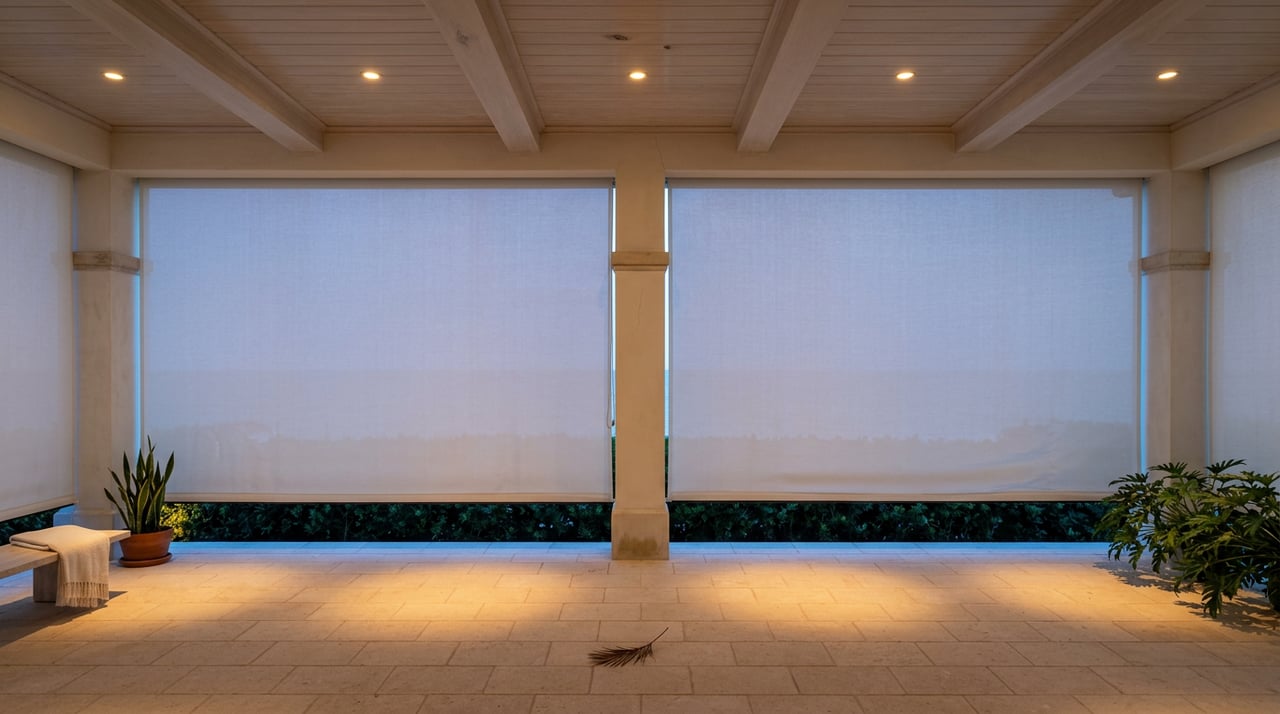
- Seaward windows drawn after sunset. Interior light bleeds through glass at levels turtles perceive. Blackout blinds or lined drapes on the ocean side handle it.
- Landscape and pool lighting either off or shielded. The state-aligned principle is long-wavelength (amber/orange), low-mounted, and shielded so no source is directly visible from the beach.
- No white flashlights, no phone flash, no flash photography anywhere on or near the sand between dusk and dawn.
- Furniture, umbrellas, and kayaks pulled off the beach every evening. Hatchlings that hit an obstacle rarely recover the crawl direction.
- Holes filled and sandcastles flattened before you leave the beach. A twelve-inch depression is an overnight trap for a hatchling and a nesting female alike.
If you observe a disorientation event, a disturbed nest, or an injured or dead sea turtle, the FWC Wildlife Alert Hotline is 1-888-404-FWCC (1-888-404-3922). Dial #FWC from a mobile phone.
Who is walking your beach at 6:00 a.m.
Palm Beach's oceanfront is monitored, not casually. Loggerhead Marinelife Center now concentrates on an 8.5-mile stretch of shoreline north of the island, with FWC covering the remainder of northern Palm Beach County. To the south, in the Town of Gulf Stream, Sea Turtle Adventures conducts lighting surveys in compliance with the town code, Chapter 38, Division 2, which asks all light sources to be shielded, covered, or turned off to prevent visibility from the beach. The Town of Palm Beach's ordinance sits in between and is enforced by Town Code Enforcement, with Palm Beach County Environmental Resources Management overseeing beachfront lighting permits and inspections inside the county's Sea Turtle Protection Zone.
The practical implication for a resident: your beach is walked at dawn. Nest markers are placed. Track lines are counted. Disorientation events are traced back to the property that produced the light. Most homeowners will never hear from anyone, because most properties are quietly in compliance. The ones that are not tend to hear about it quickly during a record year, because the signal-to-noise ratio on the sand tips fast when nests are dense.
The north end has a second tenant this summer
The Town has also flagged an active least tern nesting colony on the north end of the island, a shorebird species that nests directly on open sand and is easily disturbed by pedestrians and off-leash dogs. Palm Beach's dog rules allow off-leash use on the beach between Sunset Avenue and Wells Road from dawn until 9:00 a.m., with dogs required to remain under owner control. That corridor overlaps the same stretch where tern chicks are on the ground this summer. The overlap is not a problem if the dog does what the ordinance already requires. It is a problem if the dog does not.
The 2026 season, in the numbers you would actually quote
| Metric (2026, statewide unless noted) | Figure |
|---|---|
| Leatherback nests through June 30 | 2,152 |
| Loggerhead nests through June 30 | 94,667 |
| Leatherback nests on Boca Raton beaches by early June | 42 (more than 2x local average) |
| Earliest nest in LMC's monitoring history | February 11 |
| Ordinance-mandated lights-out window on Palm Beach | March 1 – October 31 |
Read those together and the shape of August becomes clear. A larger-than-usual cohort of eggs is hatching into the same finite stretch of beach, under a lighting ordinance that has not tightened but is now doing much heavier lifting. The compliance floor did not move. The consequences of standing on it moved.
A note for owners thinking about the season past August
Two questions come up on the island every summer, and both are worth stating plainly. Renovation lighting plans on oceanfront parcels get more scrutiny in a record year, and interior-light bleed through seaward glass is the item most often missed on a project that otherwise looks compliant on paper. Retrofits usually involve tinting, upgraded window coverings, or lamp changes rather than fixture replacement, and the ERM guidance on wildlife-certified fixtures is where a contractor should start rather than finish.
The other question is whether hatch peak affects showings. The answer, for owners considering a fall listing, is that it barely affects daytime showings at all and shapes only the evening ones, and only for the ocean-facing rooms. A single walkthrough at dusk with the right blinds drawn tells you everything you need to know.
If your Palm Beach home sits on the sand and you want a candid read on how the ordinance, the lighting profile, and the fall calendar interact for your specific parcel, Debbie Gross works quietly with island owners on exactly that kind of pre-season walkthrough. Schedule a Free Consultation and we will map it out together, one room and one fixture at a time.